
Top Signs You Need Air Duct Cleaning Service – Don’t Ignore These
Most “signs you need duct cleaning” lists recycle the same five symptoms and stop there. That’s not much help when you’re standing in your hallway trying to figure out whether the dust on your register is a cleaning problem or something else entirely. We’re going to take the opposite approach here: connect each visible sign to the mechanical or contamination condition actually causing it, so you know what you’re dealing with, not just that you should call someone. If reading this makes you want a professional opinion rather than a DIY diagnosis, call (855) 658-5079.
Dust Rings Around Registers: What They Actually Tell You
Dust rings around a supply register are usually not a sign that your ducts are packed with debris. They’re more often a sign that your filter is letting particulates slip past it. That’s an important distinction, because it changes what actually needs to be fixed.
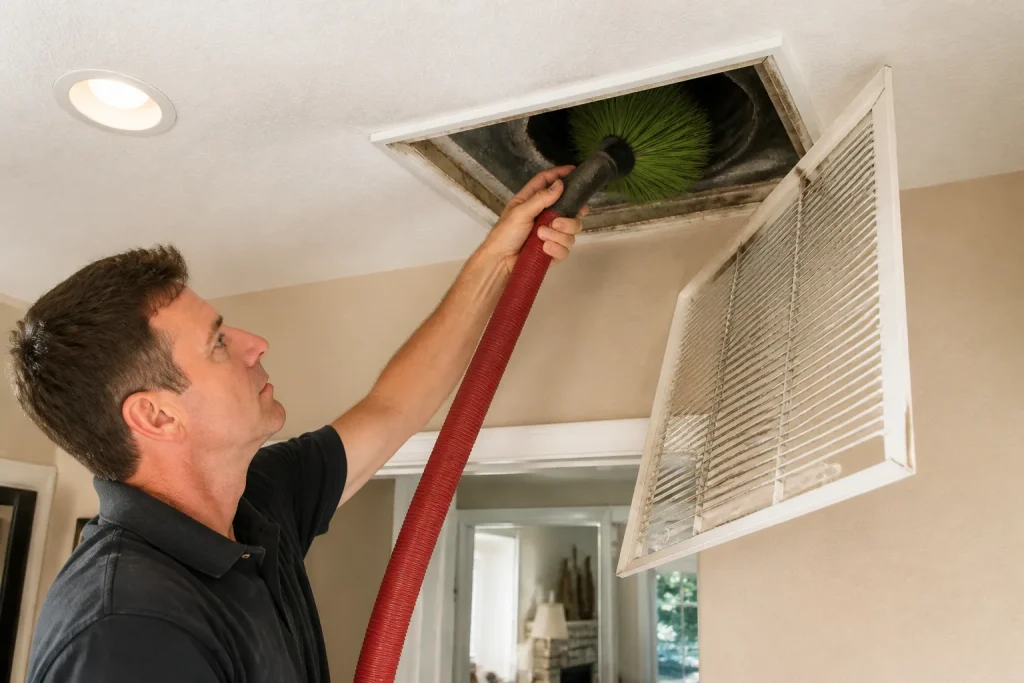
Here’s how to tell the difference with a flashlight and a white cloth. Remove the register cover and look inside the boot, the short duct run feeding the register. Wipe the inside surface with the cloth. If the cloth comes back lightly gray with an even coating, that’s normal accumulation. If it comes back with thick, sticky, dark residue, or if you can see visible debris piled at the base of the boot, that points to genuine contamination.
Then check the filter slot. A gap around the filter edges, a filter that’s the wrong size, or a low-MERV filter doing very little all point to filter bypass. The dust ring forms because unfiltered air is escaping around the filter and settling at the register.
- Even gray film inside the boot: normal, watch and wait
- Thick dark buildup or visible debris: cleaning is worth discussing
- Dust ring present but boot clean: look at the filter, not the duct
- Gaps around the filter: filter bypass, fix the seal first
In Highlands, where dry air and seasonal swings already push dust around, filter bypass gets misdiagnosed as duct contamination constantly. We’d rather tell you which one you have.
Inconsistent Room Temperatures: Cleanliness or Balancing?
Uneven room temperatures are more likely a duct balancing or leakage issue than a cleanliness issue. That’s the part most people get wrong. A room that runs hot in summer and cold in winter usually has a damper problem, a leaky duct joint, or a run that’s undersized, not a duct full of dust.
Cleaning helps temperature consistency only in one specific case: when contamination has physically restricted airflow through the duct run or blocked the evaporator coil. Restricted airflow means the system can’t deliver the air it’s supposed to. That’s a mechanical restriction, not just dirt sitting on a surface.
How to think about it:
- If one room is consistently off while others are fine, suspect a damper or a leaky run.
- If the whole house feels weak and the filter is clean, suspect a restriction somewhere in the system.
- If airflow is weak and you can hear whistling at registers, suspect leakage at joints.
- If airflow is weak and the return side feels starved, contamination near the air handler is worth inspecting.
A thorough air duct cleaning assessment in Highlands will separate the two. If the problem is a leak, we can seal it. If it’s a restriction, we can clear it. Cleaning alone won’t fix a balancing problem, and we’ll say so.
The Odor Profile: Musty, Chemical, or Something Else
Odor is the most reliable sign in this whole list, but only if you read it correctly. The key question is: does the smell appear only when the system runs?
A musty, earthy smell that shows up when the fan kicks on and fades shortly after it stops is the classic signature of biological growth inside the ductwork. Moisture has collected somewhere, whether on duct surfaces, on the evaporator coil, or in a drain pan that isn’t draining properly. Growth feeds on that moisture and releases spores into the airstream every time air moves.
A one-time event odor is different. Smoke, chemical, or burnt smells that appeared once and then faded usually came from outside the system. Those don’t recur when the fan cycles.
And a persistent stale smell even when the system is off often points to a drain pan or coil issue rather than duct contamination. That’s a mechanical fix before a cleaning issue.
- Musty, present only during runtime: likely biological growth in the ductwork
- Chemical or smoke, fading over days: a one-time event, watch it
- Stale, present even when off: check the drain pan and coil
- Sharp, localized near a register: inspect that specific run
When growth is the cause, mechanical cleaning has to come first, followed by a treatment. We use Guardsman-backed sanitizing options after the surfaces are physically cleaned, because spraying over debris doesn’t solve anything. HVAC cleaning covers the coil and air handler side of this where the moisture source usually lives.
Highlands’ Dry Air and the “3-5 Year” Rule
The standard recommendation to clean ducts every three to five years was written for average conditions, not for Highlands. Our dry, high-altitude air changes the timeline in both directions.
Dry air means less moisture-driven growth in ductwork compared to lower-elevation Colorado Front Range homes. Milder moisture load means fewer biological growth problems. But dry air also means particulate stays airborne longer and travels further before settling. Finer dust makes it past older filters and deposits deeper into the system. And the seasonal temperature swings up here, plus the volume of outdoor particulate kicked up during dry stretches, mean the accumulation rate isn’t uniform across the year.
The result: the three-to-five-year number may be too aggressive on the growth side and too loose on the particulate side for a Highlands home. What actually determines your interval:
- Whether anyone in the home has allergies or respiratory sensitivity
- Whether you have pets that shed
- How recently the home was renovated
- How well the filter is actually sealing
- Whether you’ve noticed any of the signs on this page
We’d rather give you a condition-based answer than a calendar-based one. That’s the only honest way to do it in Highlands.
After Renovation: What a Real Duct Inspection Should Reveal
Post-renovation duct contamination is its own category, and a visual check of the register faces tells you almost nothing about it. Construction dust is different in composition from household dust. It carries drywall fines, silica, sawdust, and fine mineral particles that behave differently once they’re inside the system.
What those particles do to the air handler matters. They coat the blower wheel, settle on the evaporator coil, and get pulled into the return system in volumes that ordinary filters aren’t designed to catch. A blower wheel with a coating of construction dust moves less air and runs less efficiently. A coil with fines packed into the fins loses heat-transfer capacity. Neither of those shows up at the register.
A proper post-renovation inspection involves opening access points, looking inside the return plenum and the runs closest to the air handler, and checking the blower compartment and coil. That’s where the debris actually lands. Visual register inspection is insufficient because construction dust doesn’t concentrate at the endpoints, it concentrates near the source of the airflow. If your renovation wrapped up recently and no one has looked inside the system, that’s worth a conversation.
When to Call a Pro (and What We’d Tell You)
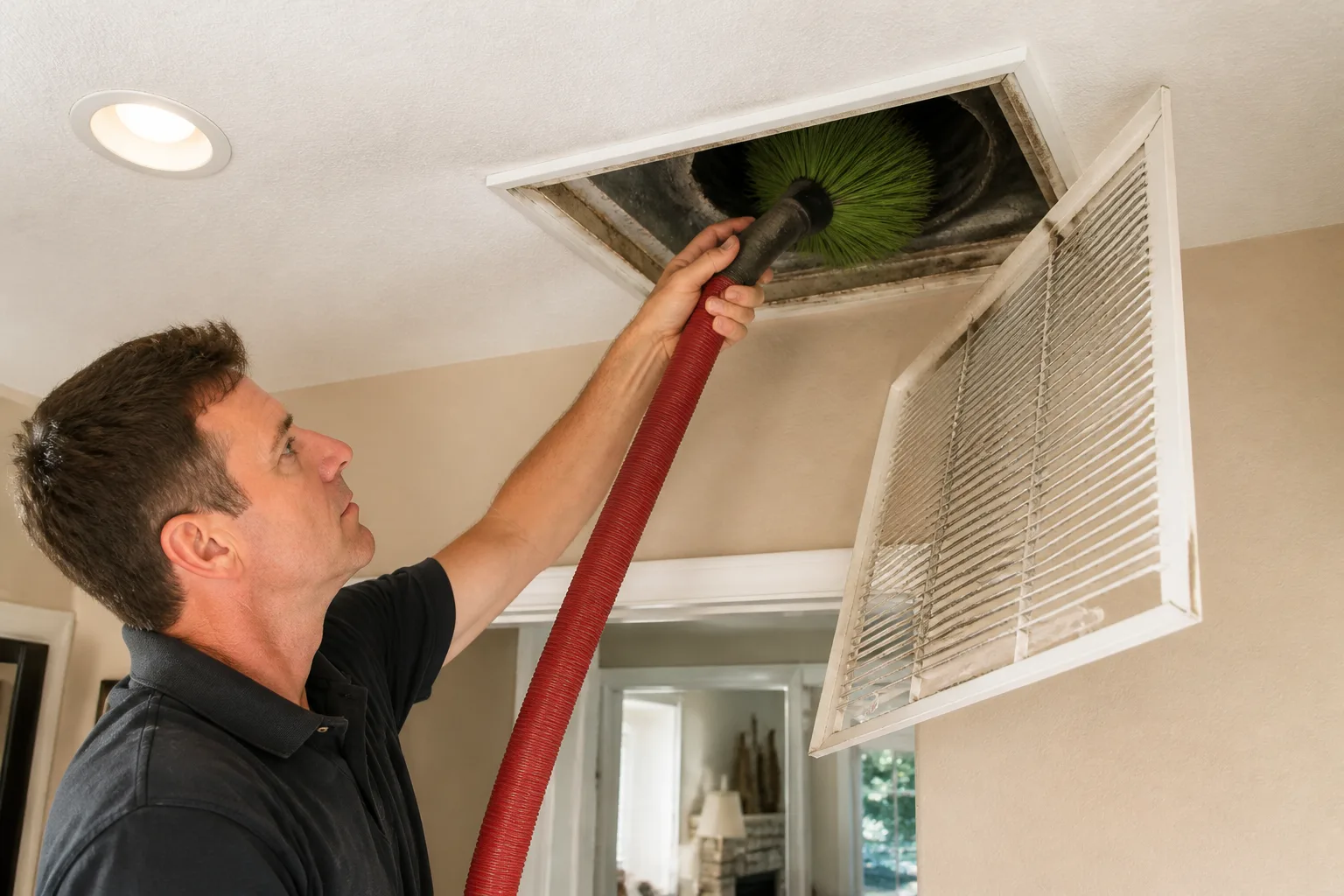
Some dust is a maintenance issue. Some is a mechanical issue. And some points to a real problem with how the system is moving air. We use professional equipment from Rotobrush, Nikro, and Abatement Technologies precisely because the difference matters: Rotobrush systems agitate and vacuum simultaneously, and Abatement Technologies filtration captures dislodged contaminants rather than recirculating them into your living space. Shop-vacs and rented equipment can’t do either safely at this scale.
Call a professional when you see thick buildup inside the boot, when musty odor appears only during runtime, or when post-renovation dust might have reached the air handler. One thing worth checking yourself first: your dryer vent cleaning interval. Lint buildup in a dryer vent is a fire concern most duct cleaners skip, and it’s a separate system from your HVAC ducts.
One light note: if you’ve convinced yourself the dust ring is definitely the ducts and definitely not the filter, we understand the instinct. Filters get defensive about these things. We’ll check both and tell you honestly which is the culprit.
Related services in Highlands: air duct cleaning, HVAC cleaning, duct repair and sealing, and dryer vent cleaning.
The Bottom Line
The signs worth paying attention to are specific. Dust rings usually point to filter bypass, not duct contamination. Uneven temperatures usually point to balancing or leakage. Musty odor during runtime points to biological growth. And post-renovation dust needs an inspection that goes past the register faces.
Our technicians have up to 13 years of experience reading these signs, and the answer isn’t always “clean the ducts.” Sometimes it’s “fix the filter seal” or “seal the leak” or “clean the coil.” We use professional-grade equipment on every job, we clean, sanitize, repair, and seal in one visit so we’re not leaving a problem half-finished, and we recommend filtration hardware from Honeywell and Aprilaire after cleaning so the improvement lasts.
If you’re in Highlands and want a straight answer about what’s actually going on in your system, Air Duct Cleaning Highlands offers free estimates. Call (855) 658-5079 and we’ll take a look. We answer 24/7. Fast dispatch from 7am to 7pm, Sunday through Friday.
Frequently Asked Questions
Wipe inside a supply boot with a white cloth. A light even gray film means normal buildup, so check your filter fit first. Thick, dark, sticky residue or visible debris means cleaning is worth discussing. Most dust rings are filter bypass, not duct contamination.
Only when the cause is contamination restricting airflow. Uneven temperatures are more often a balancing or leakage issue, which cleaning won’t fix. Call (855) 658-5079 and we’ll help you tell the difference. Estimates are free.
There’s no single calendar answer for Highlands. Our dry, high-altitude air reduces moisture-driven growth but lets fine particulate travel deeper into the system. Condition matters more than years: pets, allergies, recent renovations, and filter seal quality all shift the interval.
No. Musty odor that appears only when the system runs points to biological growth in the ductwork. A stale smell present even when the system is off more often points to a drain pan or coil issue. Call (855) 658-5079 so we can pinpoint the source before anyone starts cleaning.
Written by the team at Air Duct Cleaning Highlands.
Need Air Duct Cleaning Help?
Call Air Duct Cleaning Highlands - the local pro we connect you with is licensed and insured, here with fast help in Highlands.
(855) 658-5079